


__________________________________________________________________________________

RFID (Radio Frequency Identification) is a technology that uses radio waves to automatically identify, track, and manage items tagged with an RFID label or tag.
Unlike traditional barcodes, RFID does not require a direct line of sight between the scanner and the item. Multiple tagged items can be read simultaneously, making RFID ideal for warehouses, manufacturing, retail, and supply chain operations.

How RFID Works
-
RFID Tag or Label
-
Contains a microchip and antenna.
-
Stores unique information about an item.
-
-
RFID Reader
-
Sends out radio waves to communicate with RFID tags.
-
Receives data transmitted from the tags.
-
-
Antenna
-
Facilitates communication between the reader and RFID tags.
-
-
Software System
-
Collects, processes, and integrates RFID data with systems such as WMS, ERP, or inventory management software.
-
Key Benefits of RFID
-
Automatic Data Capture — No manual scanning required.
-
Faster Inventory Counts — Read hundreds of items in seconds.
-
No Line-of-Sight Required — Tags can be read through packaging and containers.
-
Improved Inventory Accuracy — Reduces human errors.
-
Real-Time Visibility — Track products throughout the supply chain.
-
Reduced Labor Costs — Automates inventory and shipping processes.
-
Fewer Mis-Shipments — Verifies shipments before they leave the facility.
Common Applications
-
Warehouse inventory management
-
Distribution centers
-
Manufacturing work-in-process tracking
-
Retail inventory management
-
Asset tracking
-
Shipping verification
-
Pharmaceutical and healthcare tracking
-
Cold chain monitoring
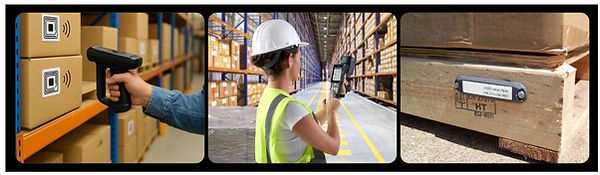
In short, RFID enables businesses to automatically identify and track assets, inventory, and shipments in real time, improving efficiency, accuracy, and visibility across operations.
RFID vs. Barcode Technology
Both RFID and barcode technologies are used to identify and track products, assets, and inventory throughout the supply chain. However, RFID offers several advantages over traditional barcode systems, especially in high-volume operations.

Types of RFID Tags: UHF, HF, and NFC
RFID technology operates across different frequency ranges, each designed for specific applications and environments. The three most common RFID technologies are Ultra-High Frequency (UHF), High Frequency (HF), and Near Field Communication (NFC).
1. UHF RFID (Ultra-High Frequency)
Frequency Range: 860–960 MHz
UHF RFID is the most widely used RFID technology in supply chain, logistics, warehousing, and retail environments because it offers long read ranges and fast bulk-reading capabilities.
Key Characteristics:
-
Long read range (up to 30+ feet depending on the system)
-
Reads hundreds of tags simultaneously
-
No line-of-sight required
-
Ideal for high-volume environments
Common Applications:
-
Warehouse inventory management
-
Distribution centers
-
Shipping verification
-
Retail inventory tracking
-
Manufacturing operations
-
Asset tracking

Advantages:
✔ Fast read speeds
✔ Bulk scanning capabilities
✔ Long read distances
✔ Real-time inventory visibility
2. HF RFID (High Frequency)
Frequency Range: 13.56 MHz
HF RFID operates at shorter distances than UHF but performs well in environments containing liquids and metals.
Key Characteristics:
-
Read range typically up to 12 inches
-
Moderate data transfer speed
-
Better performance near liquids and metals than UHF
Common Applications:
-
Library systems
-
Access control
-
Ticketing systems
-
Healthcare applications
-
Work-in-process tracking
Advantages:
✔ Reliable short-range communication
✔ Good performance around challenging materials
✔ Higher data security options

Choosing the Right RFID Technology
-
Choose UHF RFID for warehouses, logistics, manufacturing, and retail inventory.
-
Choose HF RFID for access control, healthcare, libraries, and environments with liquids or metals.
Components of an RFID Labeling System
An RFID labeling system consists of several integrated components that work together to identify, track, and manage products throughout the supply chain. Each component plays a critical role in ensuring accurate data capture and real-time visibility.
1. RFID Label or Tag
The RFID label is the foundation of the system. It combines a traditional printable label with an embedded RFID inlay.
An RFID label typically includes:
-
RFID Microchip – Stores product information and a unique identification number.
-
Antenna – Sends and receives radio frequency signals.
-
Face Stock – Printable label material for human-readable text and barcodes.
-
Adhesive Layer – Allows the label to be securely attached to products, cartons, or pallets.
-
Release Liner – Protects the adhesive until application.
Primary Function: Stores and transmits item-specific data.
2. RFID Printer/Encoder
RFID printers not only print text, graphics, and barcodes onto labels, but they also encode information onto the RFID chip simultaneously.
Common capabilities include:
-
Printing variable information
-
Encoding EPC numbers
-
Verifying successful encoding
-
Printing barcodes and human-readable text
Examples include industrial RFID printers from manufacturers such as Zebra.
Primary Function: Prints and programs RFID labels.
3. RFID Reader
RFID readers communicate with RFID tags using radio waves.
Readers can be:
-
Fixed readers mounted at dock doors or conveyor systems
-
Handheld mobile readers used for inventory counts
-
Vehicle-mounted readers installed on forklifts
Primary Function: Captures data stored on RFID labels.
4. RFID Antennas
Antennas transmit and receive radio frequency signals between RFID readers and RFID labels.
Different antenna designs are available depending on application requirements.
Examples include:
-
Portal antennas
-
Conveyor antennas
-
Shelf antennas
-
Overhead antennas
Primary Function: Creates the read zone where RFID tags are detected.
5. Middleware or RFID Software
Middleware collects, filters, and manages RFID data before sending it to business systems.
Typical software functions include:
-
Filtering duplicate reads
-
Event management
-
Data validation
-
Reporting and analytics
Primary Function: Converts raw RFID data into actionable business information.
6. Business Systems Integration
RFID systems often integrate with existing enterprise software platforms, including:
-
Warehouse Management Systems (WMS)
-
Enterprise Resource Planning (ERP)
-
Manufacturing Execution Systems (MES)
-
Inventory Management Systems
Integration enables organizations to automate workflows and gain real-time visibility.
Primary Function: Uses RFID data to drive business processes.

Key Benefits of an RFID Labeling System
-
Improved inventory accuracy
-
Real-time supply chain visibility
-
Reduced manual scanning labor
-
Faster receiving and shipping
-
Fewer stockouts and mis-shipments
-
Automated data collection
-
Enhanced traceability and compliance
Not Sure Which RFID Label You Need?
Tell us:
-
What you're labeling
-
Label size
-
Quantity
-
Material/surface
-
Printer/encoder
-
Application
GET AN RFID RECOMMENDATION