UHF RFID Tag Inlays: The Technology Behind Smart Labels
What Is a UHF RFID Tag Inlay?
A UHF RFID tag inlay is the core component that transforms a standard thermal transfer label into a smart RFID label. It consists of a tiny microchip connected to an antenna, all mounted on a thin substrate that is embedded inside the label.
When printed and encoded with an RFID-compatible thermal transfer printer, the inlay enables each label to store a unique Electronic Product Code (EPC), allowing products to be identified, tracked, and managed automatically throughout the supply chain.
Whether you're managing inventory in a warehouse, tracking assets, or improving shipping accuracy, the RFID inlay is what makes intelligent labeling possible.

How Does a UHF RFID Tag Inlay Work?
A UHF RFID system consists of three primary components:
UHF RFID Tag Inlay
Embedded inside the thermal transfer label, the inlay contains:
-
RFID microchip
-
RFID antenna
-
Adhesive substrate
Each inlay stores a unique digital identity for every item.
RFID Reader
An RFID reader emits radio frequency signals that energize nearby RFID tags. The tags respond by transmitting their unique identification information back to the reader.
Unlike barcodes, RFID does not require direct line-of-sight scanning.
RFID Software
The collected RFID data is processed through inventory management, warehouse management (WMS), or ERP software to provide real-time visibility into inventory movement.


Components of a UHF RFID Inlay
RFID Microchip
The microchip stores information such as:
-
Electronic Product Code (EPC)
-
User Memory (when applicable)
-
Tag identification data
-
Security information
Each chip contains a unique identifier that distinguishes every tagged item.
RFID Antenna
The antenna captures energy from the RFID reader and transmits information stored on the chip.
A properly selected antenna design directly impacts:
-
Read range
-
Read reliability
-
Read speed
-
Performance around various materials


Substrate
The substrate securely holds the chip and antenna together before being laminated into the thermal transfer label.
It is designed to remain thin, flexible, and durable.
Benefits of UHF RFID Tag Inlays
Faster Inventory Counts
Instead of scanning one barcode at a time, hundreds of RFID-tagged items can be read simultaneously.
Inventory counts that once required hours can often be completed in minutes.

Improved Inventory Accuracy
RFID significantly reduces manual scanning errors while providing real-time inventory visibility.
Benefits include:
-
Reduced stock discrepancies
-
Better inventory reconciliation
-
Fewer lost products
-
Improved replenishment accuracy
No Line-of-Sight Required
Unlike traditional barcodes, RFID tags can be read without directly seeing the label.
Readers can detect tags through:
-
Cardboard boxes
-
Plastic containers
-
Shrink wrap
-
Sealed cartons


Faster Receiving
Incoming shipments can be verified quickly by reading multiple RFID tags at once.
Benefits include:
-
Faster receiving processes
-
Improved shipment verification
-
Reduced manual labor
-
Increased dock productivity
Faster Shipping
RFID helps verify outgoing shipments before they leave the warehouse.
Benefits include:
-
Improved order accuracy
-
Fewer shipping mistakes
-
Reduced chargebacks
-
Increased customer satisfaction

Real-Time Inventory Visibility
RFID enables organizations to know what inventory is available without relying solely on manual counts.
This provides better decision-making throughout the supply chain.
Improved Product Traceability
Each RFID label carries a unique identity, making it possible to track products throughout manufacturing, distribution, and delivery.
This is especially valuable for:
-
Manufacturing
-
Distribution
-
Healthcare
-
Automotive
-
Food & Beverage
-
Industrial Equipment

Choosing the Right RFID Inlay Matters
Not every RFID tag inlay performs the same.
Selecting the proper inlay depends on several factors.
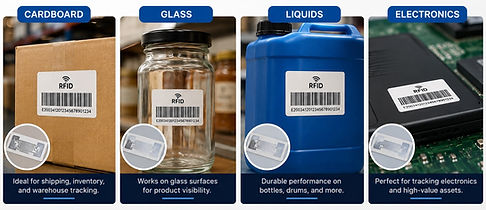
Product Material
Different materials affect RFID performance differently.
Examples include:
-
Metal
-
Plastic
-
Cardboard
-
Glass
-
Liquids
-
Electronics
Label Size
The available label size often determines which RFID inlay can be used.
Selecting the correct inlay ensures optimal read performance while fitting your product requirements.
Read Range Requirements
Applications vary greatly.
Some require reading products within a few feet, while others require longer read distances.
Choosing the proper inlay ensures reliable performance.
Packaging Configuration
Performance can vary depending on whether
products are:
-
Individually packaged
-
Cartoned
-
Palletized
-
Shrink wrapped
-
Stored closely together

Application Environment
Environmental conditions may influence RFID performance, including:
-
Indoor warehouses
-
Manufacturing facilities
-
Distribution centers
-
Cold storage
-
Outdoor environments
Industries Using UHF RFID Tag Inlays
UHF RFID technology is widely used across industries including:
-
Warehousing
-
Logistics
-
Distribution
-
Manufacturing
-
Retail
-
Healthcare
-
Pharmaceutical
-
Automotive
-
Food & Beverage
-
Asset Tracking
-
Supply Chain Management


Why Choose DockitRFID?
At DockitRFID, we help businesses select the right UHF RFID tag inlay for their specific application... not just the right label.
Our factory-direct RFID thermal transfer labels are designed to deliver reliable encoding performance, excellent read rates, and consistent quality for today's demanding supply chains.
Whether you're implementing RFID for the first time or expanding an existing system, our team can help you choose the right RFID solution based on your products, environment, and business goals.
What You Can Expect from DockitRFID
-
Factory-direct pricing
-
Premium UHF RFID thermal transfer labels
-
Multiple RFID inlay options
-
Fast turnaround times
-
Expert application guidance
-
Solutions for warehouses, manufacturers, and distributors
Transforming Labels Into Smart Solutions
Ready to improve inventory accuracy, streamline warehouse operations, and gain real-time visibility?
Contact our team today to learn how the right UHF RFID tag inlay can help optimize your supply chain.